Supplier sign in
Home
STAY INFORMED
Subscribe to our monthly newsletter.
Your email address will never be disclosed to any third party.
Read our privacy notice.
Press release
10.04.2026  |  120x
Share this item
WHY SHIP AIR? – Especially when handling fibers?

Efficient fiber packaging: From handling to valve bags

Fibers place high demands on processing – from material handling to filling. A fully automated vacuum bagging line shows how process stability, product quality, and logistics efficiency can be significantly improved.

Why ship air?

Extremely lightweight products with high air retention pose specific challenges throughout the entire process chain. Especially when handling fibers challenges begin long before the actual filling step, because fibers are not a standard bulk material.

Not only the filling process

In addition to the filling process itself, material handling upstream of the filling system plays a critical role in ensuring overall process stability. Irregular feeding, inconsistent distribution within the pre-hopper, and entrained air directly impact the efficiency and quality of downstream packaging.

Challenges in fiber processing

  • inconsistent feeding of the pre-hopper
  • bridging and unstable material flow
  • high air content within the product
  • fluctuating filling weights
  • unstable bag filling behavior
  • bag inflation during the filling process
  • fiber fly and release of fine particles
  • reduced payload per bag
  • limited shape stability during transport
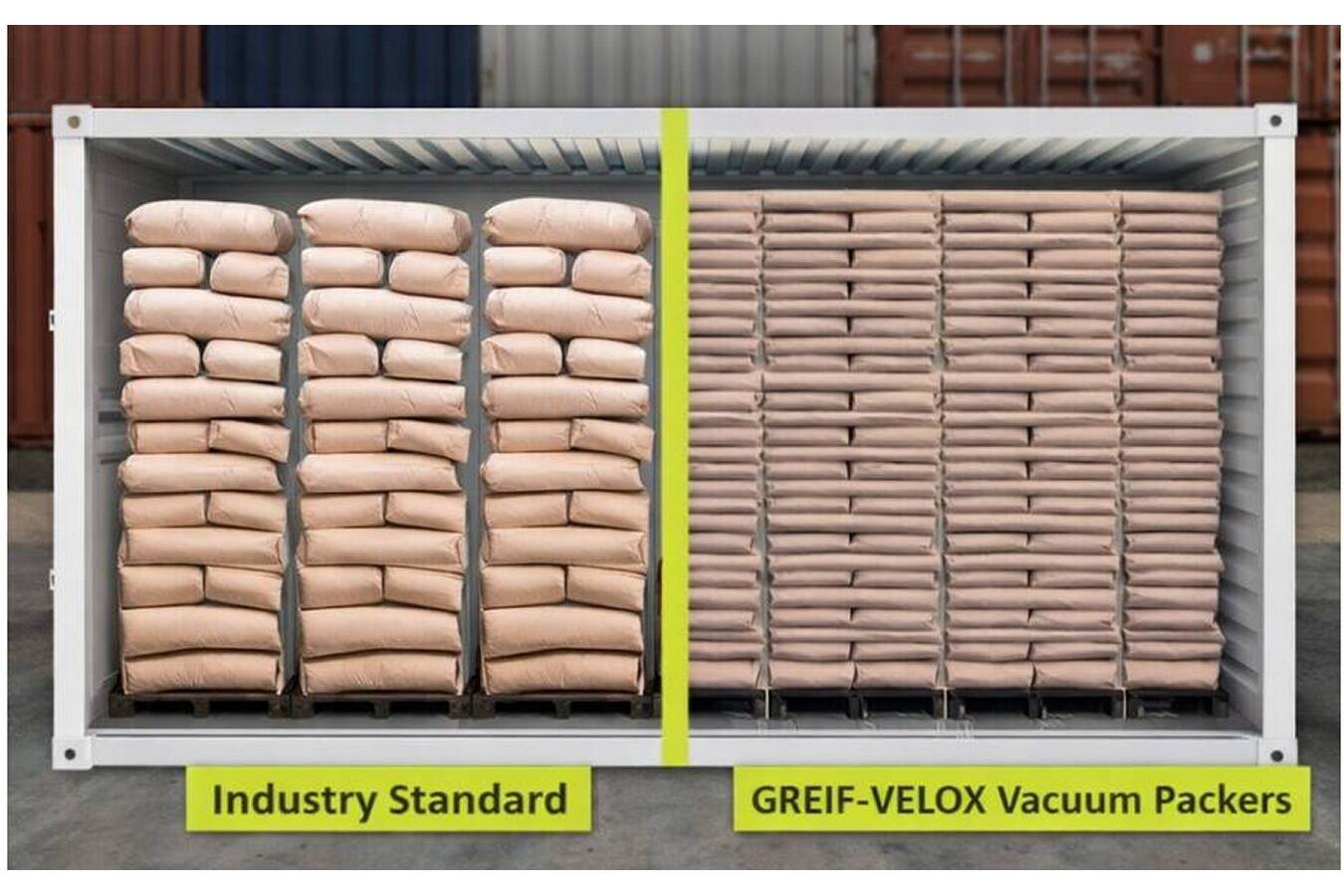
  • inefficient container utilization

Full-line integration + vacuum technology

To address these challenges, fully automated full-line systems are increasingly used, integrating both upstream handling and the filling process. At the core of such systems is a dual-spout vacuum bagging machine for valve bags, where the air contained in the product is actively reduced during filling. At the same time, a controlled and consistent material feed from the pre-hopper ensures a stable product flow.

Example of an integrated system

A typical system configuration combines multiple process steps into one continuous line. Such a system can achieve a capacity of up to 80 bags per hour, depending on bag sizes, for example 6.5 kg and 12.5 kg. It consists of:
  • vacuum bagging via two filling spouts
  • flexible handling of different bag formats through an adapted bag gripper
  • automated sealing of valve bags
  • bag equalization for improved shape stability
  • downstream palletizing

Measurable improvements

  • more stable and reproducible filling processes
  • consistent filling weights
  • compact and shape-stable bags
  • improved stacking and transport behavior
  • more efficient use of storage and transport capacity

Conclusion

Fiber processing requires a coordinated interaction between material handling and filling technology. Integrated system concepts combined with vacuum technology enable significant improvements in both process stability and overall logistics efficiency.

Company information

Related trade show

More items

Compaction of Ultra-Lightweight Powders: Why ship air? Compaction of Ultra-Lightweight Powders as a Logistics Efficiency Factor
Ultra-lightweight powders such as pigments, carbon black, silica, cellulose fibres or specialty additives present a fundamental challenge:
Compaction of Ultra-Lightweight Powders: Why ship air?
Compaction of Ultra-Lightweight Powders as a Logistics Efficiency Factor Ultra-lightweight powders such as pigments, carbon black, silica, cellulose fibres or specialty additives present a fundamental challenge: During filling, the material contains a high proportion of air. If this air is not specifically removed, it significantly reduces the effective product quantity per bag and per transport unit. The Influence of Bulk Density on Container Utilization A standard 20-foot container typically holds approximately: 10,080 kg per container when pigments are packed using conventional filling methods. By applying vacuum-assisted compaction during the filling process, container loads of up to 27,600 kg per container can be achieved. This corresponds to an increase of: +17,520 kg of product per container. The product, container size and mode of transport remain unchanged. The difference lies solely in the reduction of the air content within the bag. Economic Considerations Assuming a product value of €200 per kilogram, the calculation is as follows: 17,520 kg × €200/kg = €3,504,000 additional product value per container. This example illustrates the significant impact
02.03.2026  |  391x  |  Product description  | 
Not every filling system needs to be a custom solution Why standardized systems are often the better choice in bulk material handling.
Not every filling system needs to be a custom solution
Why standardized systems are often the better choice in bulk material handling. In industrial bulk material processing, custom-built solutions are often seen as the gold standard. Complex products, demanding processes and high requirements for efficiency and safety frequently lead to highly individualized machine concepts. However, in practice, one thing becomes clear: a large share of applications follows recurring, well-defined patterns. This is exactly where standardized filling and bagging systems come into play. Standard applications dominate the market Whether powders, granules or free-flowing bulk materials – around 80% of industrial filling tasks operate within clearly defined parameters. Conveying systems, dosing principles and bag or container types are often very similar. For these applications, a fully customized system is usually not required – and often not the most economical choice. Instead, preconfigured and proven systems are gaining importance. All systems follow the same principle: clear configurations, reduced variant
05.02.2026  |  513x  |  Product description  | 
Top 3 at Best of Industry Award: ValvoSeal Safe Recognized Greif-Velox awarded for its ultrasonic sealing innovation, enabling clean and secure closure of valve bags in powder processing industries.
Top 3 at Best of Industry Award: ValvoSeal Safe Recognized
Greif-Velox awarded for its ultrasonic sealing innovation, enabling clean and secure closure of valve bags in powder processing industries. ValvoSeal Safe Recognized as Top 3 Finalist at Best of Industry Award 2025 Ultrasonic sealing solution from Greif-Velox impresses in the category “Process Industry – Process Engineering” Greif-Velox Maschinenfabrik GmbH has been recognized as a Top 3 finalist at the Best of Industry Award 2025 for its patented innovation ValvoSeal Safe, competing in the category “Process Industry – Process Engineering”. The award ceremony took place on January 22 in Würzburg, Germany. Clean, secure sealing for demanding powder applications ValvoSeal Safe is an ultrasonic sealing solution for the automated, dust-free, and secure closure of valve bags—a crucial innovation for industries handling fine, reactive, or hazardous powders. The technology enables tool-free, reproducible, and 100% tight sealing of valve bags, offering: - Zero dust leakage - Improved safety and hygiene - Elimination of manual post-sealing - Fewer downtimes and optimized throughput ValvoSeal
02.02.2026  |  422x  |  Press release  | 
Smart technology against unplanned downtime According to a recent study by Deutsche Messe Technology Academy and Moxa, unplanned downtime is one of the biggest challenges facing industry.
Smart technology against unplanned downtime
According to a recent study by Deutsche Messe Technology Academy and Moxa, unplanned downtime is one of the biggest challenges facing industry. Downtime as a major cost factor in industry A recent study by the Deutsche Messe Technology Academy in cooperation with automation specialist Moxa provides insights into the reality of industrial production in Germany: 94 percent of the companies surveyed report at least one unplanned shutdown per month, with an average downtime of 3.3 hours. The effects are serious: according to the study, even one hour of production downtime can cause costs in the millions—especially in highly automated processes. The economic consequences range from missed delivery dates and increased personnel deployment to damage to the company’s reputation among customers. The study cites the following causes of unplanned downtime as particularly common: Main causes of production downtime * Failure of machine components or IT systems * Lack of transparency regarding the condition of the equipment * Difficulties and delays in procuring spare parts The consequences are well known: inefficiency,
07.01.2026  |  547x  |  Press release  | 
PORTALS
Recycling-Portal Schuettgut-Portal BulkSolids-Portal
SIGN UP FOR OUR NEWSLETTER
Newsletter archive
Service and contact
ContactDisclaimerPrivacyAdvertising
FOLLOW US
Linked